A new domain.
“Governments of the Industrial World, you weary giants of flesh and steel, I come from Cyberspace, the new home of Mind. On behalf of the future, I ask you of the past to leave us alone. You are not welcome among us. You have no sovereignty where we gather. […] Your legal concepts of property, expression, identity, movement, and context do not apply to us. They are based on matter. There is no matter here. Our identities have no bodies, so, unlike you, we cannot obtain order by physical coercion. […] In China, Germany, France, Russia, Singapore, Italy and the United States, you are trying to ward off the virus of liberty by erecting guard posts at the frontiers of Cyberspace. These may keep out the contagion for a small time, but they will not work in a world that will soon be blanketed in bit-bearing media. […] We must declare our virtual selves immune to your sovereignty, even as we continue to consent to your rule over our bodies. We will spread ourselves across the Planet so that no one can arrest our thoughts. We will create a civilization of the Mind in Cyberspace. May it be more humane and fair than the world your governments have made before. A Declaration of the Independence of Cyberspace.”
Davos, Switzerland, February 8, 1996, John Perry Barlow.
Something immense has happened. The level of disruption is such that we are barely waking from the shock. The fog is beginning to lift and we are starting to understand the virtues and consequences of confronting what is undoubtedly the greatest crisis in all of human history. An innovation that represents an alteration — in every sense — of the logic of violence. Cyberspace.
Cyberspace is a new domain that lacks physical borders and is indifferent to your location, language, gender, race, economic power, physical strength, or military might. So who are you, really, in cyberspace? What harm can be done to you there? And who protects you in it? These seem like unimportant questions if we regard the Internet as a kind of divine ether that flows but, being intangible, cannot cause real-world harm. Nothing could be further from the truth.
The Leviathan’s inability.
Imagine sitting at your kitchen table with your mobile device while having breakfast before work. You receive an email from your bank informing you of the urgent need to update your details or your account will be blocked, asking you to click a button. You click — it’s your bank’s website, or so it appears. You enter your login credentials. The page doesn’t load. You try again, still nothing. It’s getting late; you need to go to work. You leave it for later and forget about it. A few days later, you find strange charges on your card. You call the bank, you complain. They can’t do anything other than block your card. You mention the email you received a few days ago and they tell you you’ve been the victim of phishing — someone impersonated your bank and you fell for it. Confused and angry, you head to the old Twitter (now X) to vent. You post, start scrolling the feed, and see ads related to an intimate conversation you had with your partner a few days ago. You feel watched. Someone has invaded your privacy. Days later, you go to the office to find all your colleagues gathered, doing nothing. The company has come to a halt — someone broke into the system and encrypted the entire database, demanding a ransom in bitcoin. They’ve been the victim of ransomware. The business has a serious problem: it has put key client data at risk and, worse, its own business model. You hear the legal advisors comment that in such cases it’s better not to pay and to file a report instead. You remember your situation with the bank, take advantage of the free time, and go to the police. They listen, hand you a sheet with your statement, and tell you they’ll investigate. Weeks pass and… NOTHING.
The State, that all-powerful mastodon capable of bending the strongest will, that which holds the monopoly on violence — is useless in cyberspace. It is incapable of providing any protection against the threats that lurk there. And this is very simple to explain. The State is conceived for mass physical violence; the idea of transplanting it to another dimension and segregating it simply causes its bureaucracy to short-circuit. Given response times and costs, a case like the one above (a real case) stands no chance of being resolved.
This undoubtedly represents a paradigm shift. It collides head-on with every preconceived idea of protection in human history. Never in our lives have we been as vulnerable as we are today. Let’s look at some data:
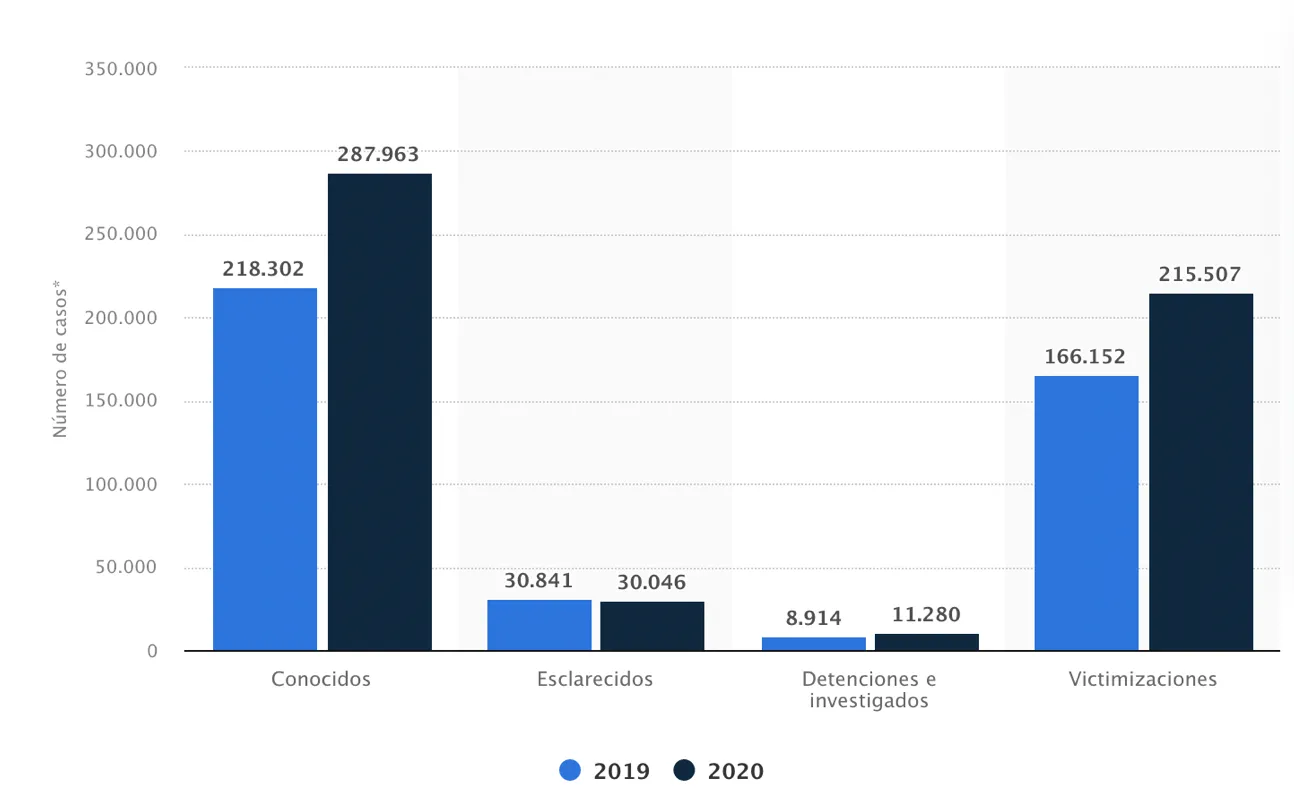
Victimizations and known, cleared, and investigated cybercrime cases in Spain in 2019 and 2020. Statista, 2021.
Let’s analyze a couple of figures from this chart. At first glance, the results are quite bleak. It should be noted that Spain is the only country in the Ibero-American sphere that provides such clear figures. By 2020, only 10.43% of cases were cleared, and only 3.91% had any kind of arrest or ongoing investigation — and the trend only grows in favor of cybercriminals. And these are only the figures relating to reports filed; we don’t know what lies beyond. The numbers are unequivocal. Can you imagine these figures in relation to physical security?
Let’s move on to other countries. Unfortunately, this research found no official data on filed vs. resolved cybercrime reports for Latin American countries — once again revealing the institutional weakness of the region. Although based on data from specialized cybersecurity firms, we can observe in their annual reports the macro-level volume of attacks and get a sense of the magnitude of what is happening.
“The Latin America and Caribbean region suffered more than 360 billion cyberattack attempts in 2022. Mexico received the highest number of attack attempts (187 billion), followed by Brazil (103 billion), Colombia (20 billion), and Peru (15 billion).” (ITware & ITware, 2023)
Chile, one of the most cyberattacked countries in the region. ITware & ITware, 2023
Now I ask you: do you still trust the State to protect you digitally? And furthermore — do you still believe you are too unimportant to have anything to protect or hide in cyberspace?